
terça-feira, 9 de outubro de 2018
On Frankenstein
Before we start, I would like to note that “Frankenstein” is the name of the scientist, not the monster. Although the creature is sometimes called “Adam Frankenstein” – the first name being a reference to the biblical man, Who was created from Clay by God; the last name referencing the fact that the monster is Frankenstein’s “child” – by the some people, it was never referred as such in the novel.
The novel Frankenstein is considered the first gothic novel – a literary genre intended to induce intense emotions on the reader, specially fear – set outside the Middle Ages as well as the first true science fiction story; this isn’t that surprinsing when you learn that Mary Shelley, the author of the book, was associated with both the Romantic and the Enlightenment movements.
Shelley was just eighteen years old when she wrote what would become a classic. The Idea for the story, like of many other horror stories, came from a nightmare; what is appropriate, considering that the lifes of both scientist and monster become nightmares trough the course of the story.
The subtitle of the novel, “The Modern Prometheus”, is a reference to the Greek myth of the eponymous titan that steals fire, a holy element, from the gods and gives it to humanity. This subtitle refers to the role of the doctor Victor Frankenstein, who, by creating the monster, “steals” the Power of giving life from Nature. The result of his trickery is a foul creature, a being so abominable that our hero can barely look at. However, it must be noticed that Adam isn’t the sole monster here. Instead of assuming responsibility for his creation, who just wanted to be loved, Victor shuns him and forces him to leave his house, solely because Adam wasn’t good looking.
The monster is then attacked by everyone who meets him, out of prejudice against his appearance. Embittered by this miserable existence, the creature decides to make the life of his creator just as bad as his own. The resto f the story is a great conflict between creator and creation, with Adam killing everyone Victor loves and Victor finally deciding to end this.
The relevance of “Frankenstein” to modern days comes from its social commentary about the ethics of science: How far are we allowed to go in the name of progress and the quest for knowledge? Whenever scientists meddle with Biology, people say they are “playing God”, just like our “hero”. In fact, “Frankenstein food” is even a pejorative name used to refer to genetically altered food, implying they are dangerous to humans.
Another topic raised by the novel is the concept of artificial life. WHat will happen when robots become inteligent enough to be considered “living”, sentient beings? Will we be prepared for that? Whatever the case, we must learn from Frankenstein’s mistakes and assume responsibilities of our meddlings.


domingo, 7 de outubro de 2018
Tokusatsu
The roots of the tokusatsu genre date back to 1954, with the first Godzilla movie. Godzilla stood out because of two things: First, the technique used to create the monster, called “suitmation”. Suitmation consisted of an actor wearing a costume of the monster; it was a cheaper alternative to stop-motion, the “CGI” of the time. This technique revolutionized Japanese film-making, and it is still used today, as Power Rangers can show. In my opinion, this is much cooler than stop-motion.
The other factor to the King Of Monsters’ success was the fact that the movie is an allegory to the atomic bomb, a tragedy that ravaged Japan. Godzilla is a destructive creature, obliterating everything it encounters while leaving a trail of radiation where it passes.
However, it does not do so out of malice; the big lizard is a victim of atomic bombs just like the Japanese people, it is in pain just like everyone else. Godzilla started a trend in cinema called “Kaiju Boom”, with many giant monster movies being made.
Some years later, in 1966, Tsubaraya Productions released Ultra Q and Ultraman, two shows that transported the kaiju genre from the movies to television, and the latter even spawned a number of imitators, creating the subgenre of “kyodai hero”: Giant heroes fighting giant monsters.
Then, in 1971, came Kamen Rider. Kamen Rider revolutionized the tokusatsu genre in many ways: First, it feature a regular sized hero fighting humanoid monsters (the “kaijins”).
Second: The hero, despite already having a body much more powerful than the average human, had to train in order to become a proper combatant.
Third: Both hero and monsters had the same origin: They were genetically and cybernetically altered humans, created by the evil organization Shocker.
This overlaps with the fourth item of the list: The monsters are victims of Shocker just like the hero and the very people they kill. The only thing that prevented Kamen Rider from becoming a kaijin under Shocker’s command was the fact that he managed to escape from Shocker’s laboratory before suffering brainwash. This makes the hero reluctant to fight the monsters, and regretful in destroying them.
Four years later, in 1975, came Himitsu Sentai Goranger, a show featuring a group of five color coded heroes fighting monsters that become giant after being destroyed. This is the first show of what would become the Super Sentai franchise, which would in turn have its shows adapted to western audiences as Power Rangers.
My interest for the tokusatsu genre started with the shows Madan Senki Ryukendo and Kamen Rider Dragon Knight – and adaptation of the Japanese show Kamen Rider Ryuki. Although I have already known about Ultraman, it were these two that sparked my liking for the thing. I think what made me so involved with those shows was the solid and mature storytelling they provided –even Ryukendo, that is very comedic-.
Since I met these shows I began to research about tokusatsu on the internet to learn more about the genre. After some time, I decided to create my own tokusatsu hero. At the time I thought the word “Slash” sounded pretty cool, so I decided to call my hero “Slashman”. Slashman was created as a comic book, since I used to make a lot of -terrible – comics at the time. I made a total of sixteen issues that you can read here:
http://hfablogs.blogspot.com/search/label/Slashman
I spent my whole teens working on this story, until the day I realized I was running in circles. Fortunately, now I have –or at least I think I have- a better understanding of how things work and I hope I will to finally find the destination of my journey, wherever it may be.
sábado, 23 de janeiro de 2016
Slashman: Capítulo 16
E aí pessoas. Como vão? Após alguns meses de pesquisa e treino, eu lhes trago o 16º capítulo de Slashman.
E feliz aniversário pra mim!
(Não se esqueçam de abrir as imagens em novas guias para uma melhor visualização)


sábado, 11 de abril de 2015
15º Capítulo de Slashman
Há quanto tempo, hein? Eu andei praticando desde o último capítulo, e acho que tanto a arte quanto o roteiro deram uma
melhorada considerável. Um amigo meu recomendou que eu usasse a fonte New Wild Words pras falas ficarem mais estilizadas,
e como essa fonte só tem uma caixa eu resolvi usar cores pra diferenciar os tons de voz. Vermelho é grito e azul é uma voz
profunda e imponente. Ah sim, abram as imagens em outra guia para uma melhor visualização.
E não se esqueçam de comentar!


quarta-feira, 8 de janeiro de 2014
.jpg)
segunda-feira, 16 de dezembro de 2013
14º Capítulo de Slashman
Eaê, gente! Já faz um bom tempo que a gente não se vê, não é mesmo?
Ooi, tem alguém aí?
Ok, então tá.
Tinha tanta coisa que eu queria falar, mas acho que só vou deixar o novo capítulo de Slashman aqui. Espero que se divirtam.


terça-feira, 30 de julho de 2013
FELIZ ANIVERSÁRIO DANIEL!!!
E AÊ PESSOAL!!! Sentiram minha falta? (Sei que não)
Só dei uma passadinha aqui pra postar uma homenagem ao Daniel Balague, do Ofensivo Por Natureza.
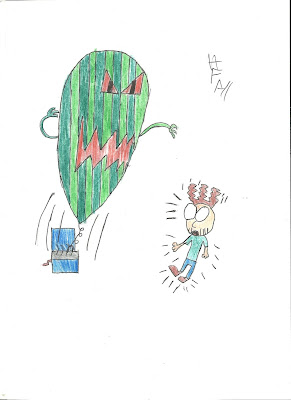 Bem, é isso. Se não entenderam a piada, perguntem pro Daniel.
 Bem, é isso. Se não entenderam a piada, perguntem pro Daniel.
Assinar:
Postagens (Atom)


